Sunday, September 11, 2016

Absent Students: What to do...what to do?

I am a practitioner of the Modeling Methodology and have been for about 15 years. 

A colleague of mine sent an email the other day that asked me:

"I am wondering how you handle the logistics of students being absent and not having a textbook during modeling. How do they catch up?"

I feel that my reply is good enough to share.

Great question!


I get questions like this all the time from first time modeling workshop participants.
I don't think this is why you're asking but let me provide the scenario that I encounter.
There is an inherent supposition by teachers who are thinking of transitioning to a new methodology that "if they switch it should fix all of the problems in the classroom".
When I write it down it seems ridiculous.  But I get this a lot from participants.  Not in such an overt way but it manifests in the question, "If all of the learning happens in the classroom, what do you do with students that are absent?"
The short answer is, "The same thing you do now with students that are absent."
There is an assumption by traditional type teachers that kids can learn from textbooks, or notes/power point presentations posted on a teachers website, or Khan Academy videos.  
And often teachers who tell students who are absent to consult these resources feel like they are off the hook if they do these.  Here is an example:
Student - "I was absent yesterday; what did I miss?"
Teacher - "Get the notes from the 'notes binder', here is the worksheet and watch this video."
There are, as I see it, two problems with this.  The first is the idea that a student could really do any conceptual learning with these resources - in or out of the classroom!  It just can't happen.  They can barely even do any factual learning with these resources let alone really learn anything.  The second is the idea that it is hard for us to admit that if the student isn't there, they just can't learn.  We as teachers hold ourselves to a standard that says, "even if a student is absent, we should still be able to get them to learn what we want them to learn."  But is that really a reasonable expectation?
So when I say to participants do do "The same thing you do now with students that are absent."
What I really mean is, "Do nothing."
Sure, you can provide some notes that were taken (or they can get them from a friend) and you can give them some worksheets that were distributed - which are both reasonable and responsible.
But there is no substitute for being there.
But let's contrast some of the features of the modeling methodology with something more traditional.
In a traditional classroom, absent students are in much dire straights because often the teachers have  a schedule of topics to cover.  Like, on Monday we're "doing" constant velocity; on Wednesday we're doing constant acceleration.  They sprinkle some practice problems in on the in between days but there is very little cycling of the content and very very little checking for understanding.  If you missed it, too bad, we've moved on.
With the modeling methodology, we plan and implement the development and deployment of content over several class periods.  This allows students to develop their concepts and understandings at their own pace and we give them multiple opportunities to practice.  We're continually checking for individual and group understanding and making changes to our plan to accommodate.
So, when a student is absent, its fine because even if they missed a day they are going to have more opportunities to learn and practice.
Switching to the modeling methodology doesn't fix all of our problems,  but it does highlight some of the logistical short comings of teaching.  And it allows us to be honest with ourselves about what we can and can't do; about what is within and out of our control.

Friday, July 22, 2016

#unitrebel Why unit analysis is overrated and why cancelling units borders on criminal

The following is my opinion based on 20 years of teaching physics at various high school levels from AP C to a trig-based to an algebra-based to a collaboratively taught special education version.  

A couple of weeks ago, I was participating in a white board circle during a modeling workshop.  The white board at which we were looking contained a notation that showed something that like: (m)(kg)/(kg) = (m).
In 'student-mode' I was like, "what happened to the kgs?"
The answer came as, "then cancelled."
I then asked, "what do you mean 'they cancelled'?"
What followed was a 20 minute session of 4 or 5 know-it-alls trying to convince me that kg/kg = 1.
Now, to be honest, I was being a little bit obstinate.  But my ulterior motive was to ask the question to the group:

"Why do we spend so much time talking about units?"
"What does it even mean to 'cancel' units?
"Why do we let our students cancel units?"

In my experience working with students of all levels, units mean very little to them.  That is a hard truth given how much they mean to us -  trained physics teachers and physicists. However, units are for people who already understand units.  When you watch an expert problem solver read and interpret a physics problem, select an appropriate equation, plug in the numbers with the correct units, cancel and solve, it looks like a maestro conducting a symphony.  However, is that our students?

Introductory physics students struggle at each step of this process.  And to ask them / require them to include the units in the problem solving steps and it really does just get in the way.  We would love if it promoted better problem solving or if it helped them make more meaning of a problem.  That would be AWESOME!  And I bet for some students it probably does.  But the students who get the units are already good problem solvers and don't need the benefits we would like the units to provide?

So what do I do about things like Newtons, Joules and Amperes?
When a new topic get introduced, usually through some sort of physical experience, the question of measurement and units comes up as a question posed by the students.  With force it is easy because the spring scales they use are calibrated in Newtons.  I would rather a student know how 1 N worth of force feels like in his hand than what the base units are.

Joules are very tricky.  In fact, there not a great way for students go discover these units.  So guess what?  I don't really use them!  The students decide that the measurable energy is calculated as the area between the graph line and the horizontal axis on a Force vs. Displacement graph.  So the units of energy, as described by the students are Nm.  Does calling this a Joule give the students more of an understanding?  I don't really know.
Current is more like force in that the multi-meter they are using has units of A already so we just go with it.

If, then sometime down the road, the students want to know something like, "what exactly is a Newton/Joule/Ampere anyway?"  Then we can get down and dirty because they (hopefully) have the contextual knowledge and practice to answer the question for themselves.

We know that real learning comes through discovery and conversation.  So any discussion of units has to have those two components.  If I am just the disseminator of information about units the students aren't going to get much out of them anyway.  So by providing less information and more opportunities for the students to experience unit analysis in context I feel like I'm doing my best for them.

So what about cancelling units?

My goal is always deep conceptual understanding.  There is some problem solving in my classes but much less than in traditional physics classes.  But there is some.  So how do I answer the question, "How are students going to know what the correct units are for the answer if they don't keep track and cancel along the way?"  I get this a lot when I'm up on my unit soapbox.  Let's first address one of the central issues:  why exactly to we think (and let students think) that kg/kg = 1?

I have no evidence or experience with this.  To be honest, I am not even sure that 4/4 = 1 except that I was told that in 4th grade and I've used it ever since.  I remember in every chemistry class I've ever had using dimensional analysis to solve mol-type-problems.  And although I was proficient I never really understood how or why it worked.  But it did and that was all that mattered.

Now, I know that right about now you're probably either yelling at the screen or thinking I'm an idiot.  But let's assume that I'm not.  How does 4/4 = 1?  Or even better how does 4 apples / 4 apples = 1.

People from here have told me stuff like, "well if you take for apples and divide them into groups of 4 apples you have 1 group!"  (with indignation).  But my question is, "where did the groups come from?  There are no groups in the original statement! And where did the apples go?  Are they still there?  Are they hiding?"

Have we, as a collective group of science teachers, allowed this process to continue without questioning its understand-ability?  And think, if I am having an issue with this, what must it be like for students?
Actually I know what it is like for students: mostly they don't care.  They like to cancel units because it makes things easy for them and they don't give a shit if they understand the why.

I want to know about the why.  And I want my students to want to know about the why.

If we now take the two concepts mentioned above; unit inclusion and unit cancellation and put them together we get to the problems I've encountered with students.

Let's consider the idea of slope.  In the classroom students measure the position of constant speed buggy cars with respect to a running clock.  If the car starts some distance in front of the zero line a graph can be generated by students with a slope and an intercept.  The equation may look like:

x = 35t + 20                                         or it can look like
x(cm) = 35(cm/s) + 20(cm)

Which of these is easier to understand?  I would assert that the top is easier to understand for students.  You and I will see the bottom and understand all of the syntax.  But a student would look at the bottom and ask themselves, "Why are there so many letters?"

If we then want our students to use these equations by plugging and chugging things can go from bad to worse.  I've heard lots of students look at the bottom equation and ask, "how do I know what to plug in where?"

If you study Newton's Law of Universal Gravitation you will invariably have to deal with the Universal gravitational constant.  The value is something in the range of 6.67 x 10E-11.  But the units are N(m)(m)/(kg)(kg)  When the students get to this value and try to use it to solve a new problem, they are very confused because of all of the letters!

Why are we, as a group, so set on keeping the units intact when all we've seen is confusion from many of our students?  Unit analysis does not provide insight into the underlying physics for introductory physics students.  I think it would be amazing if it did but alas it does not (for the majority of students).

In conclusion, the traditional methods with units are fine for some students.  But I want to know, is there a better way?  I hope there is.  And I'd love to let go of the trappings of traditional instruction and brave the new world.  Let's try and see what we can do.  Students today are different from those just a couple of years ago.  I want to change and adapt.  Let's not keep doing it the old way without a real understanding of the why.  And let's help our students develop methods that work for them from their own understanding.


Wednesday, June 15, 2016

Why Teach?

The other day I was asked by a good friend to answer the question:

"Why Teach?"

I thought about it for a while and then wrote a way-too-long response.  But since I don't want to lose that thinking I thought I'd put it here too.

So I’ve been thinking on this for the past week and I think I have come to a good answer; which is I don’t know.

When I was first starting out, like 18 years ago, I was young and idealistic.  If given this question then I would have been able to provide any number of platitudes about “teaching as a calling” or wanting to “make a difference in kids’ lives”. 

However, over time the reality of teaching as a job has set in and I’ve lost a good deal of my idealism.  Not because I am less idealistic or because I have become jaded by the difficulties of the job.  But because I am more realistic about the job.  Teaching is the rare profession where it can be very challenging on a daily basis but also can be very rewarding on a daily basis.  This makes it difficult on an emotional level as well as a practical level. 

One problem that we have as a profession is over inflating our own importance.  Teachers say that they are “doing God’s work” or “doing the most important job”.  In reality the stakes in teaching are actually kind of small.  Let’s compare teaching to doctoring.  No one is going to die if I am ineffective in my job.  No lives are at stake.  Kids might not learn as much as we would like but that is actually the reality of the job anyway. 

Young and idealistic teachers have limited views of the world of teaching and of education in general.  When you’re new at a job it is often difficult to know what you don’t know.  This is actually a good thing because it keeps new teachers excited and motivated, hopefully long enough that they don't leave the profession before they get good.

So why teach?  It is hard to say.  There isn’t big money in it.  You can make a good living but you’ll never get rich.  The pension system is gone, which is tough for new teachers.  There is lots of time off, which is necessary to do the job effectively.  And every good teacher I know spends most of it working on teaching anyway.  You get to work with kids – which can be good and bad.  Politically teaching is not currently a dream job.  We are under fire from all sides about lack of accountability and legislatures are continually trying to tell us what to do.  They’ve dissolved our unions and are attacking our pensions.  Society asks us to raise their kids, to teach them, help them become productive individuals and them chastises us for not doing it effectively enough or cheaply enough. 

None of this matters to me, however.  It kind of comes with the job.  Too many of the jobs that are most important are kind of thankless.  But it is kind of a deterrent to anyone idealistic enough to think about going into teaching.

So why teach?  I guess for me it comes down to this:

Good teaching is needed. 

This sentiment is true on both the individual student level and on the societal level.
On the personal side, we can all remember the teachers that inspired us to be our best selves.  Could you imagine life without those influences?  Think about the elementary school teachers who practically raised you.  Think about that high school teacher who inspired you toward science or (insert subject are here).  Every individual needs good teachers in his life both to get them through the day and to push them toward greatness.  Without this, where would the kids be?

The concept of the “self-made man” is one that drives me crazy!  There are plenty of people (actually many very much like you) who have become successful based mainly on their own hard work, effort and vision.  But to call them self-made?  What about the countless teachers that they had in their lives?  What about the schools they went to that provided them a place to learn and grow? 

Is this enough of a reason to teach?  Maybe.

On the societal level, there is an expectation of good teaching.  Not so the kids can know more, but so that society can grow.  Look at the current political climate.  It seems, from an outside perspective, to be a debacle of monumental proportion.  But I feel that this is an amazing time.  We have arguments and debates about big ideas.  We don’t agree and have a sense that our ideas matter.  Where did all of this come from?  It came from the commitment we have to teaching.  There are lots of political concepts that make no sense, like climate change deniers.  And I feel that highlights the importance of good teaching.  We talk about these ideas because they matter.  Even if we go back to the 60s.  The political changes that took place in the 60s were a direct result of the overhauling concepts of teaching and learning put in place post world war 2.    

Is this enough of a reason to teach?  Maybe.

In my opinion teaching is not about disseminating facts or information.   Teaching is about helping students/people to learn how to learn. 

That idea – that knowing how to learn is what is important, for both the development of individuals and for the development of society – is what keeps me teaching; is in my opinion a reason to teach.

Now that I write it, it does sound kind of idealistic.  It sounds like a reason that is part of a bigger idea.  Maybe that is good.


Thursday, February 11, 2016

Block Slide Challenge

Block Slide Challenge

One of the aspects of my class that I, and the students, find most engaging are the challenges.  These are often called physics practicums but I don't really like that word we just call them challenges.

We do challenges in all levels of physics that I teach.  And I do them with the physics teachers with whom I work in the summers as well.

There is the T-Bone challenge where we try to get two constant velocity buggies to crash in the middle of the classroom.


There is the Police Chase challenge where a constant velocity buggy is chased and caught by a constant acceleration fan cart.


There is the Paper River challenge where they have to place a constant speed buggy onto a piece of paper that moves at a constant speed (it is about 3 meters wide) at some angle and it has to travel straight across and hit a target.


There is the Bombs Away challenge where students drop a sand filled balloon into a constant speed buggy from about 7 meters up.


There are lots of projectile motion challenges - from easy horizontal shoots to more complex up and down projectiles.


There is the Cup and Foil Challenge (formerly the egg challenge) where a heavy object hanging on a spring has to be dropped so that it will just touch the foil on a cup but not break through.


There is the Pendulum and Troll where they time the swinging of a pendulum to knock a troll out of a constant speed buggy.


This particular challenge happened in the AP class where they are currently studying work and energy.  Ostensibly the question is this, given a block compressing a spring; how far will the block slide before coming to a stop?

At the lab station each group has track, a block and a rubber band set between two clamps. I told them that their task was to figure out how far back to pull the block against the spring so that it would slide down the track and come to rest with part of the block hanging off the edge.

I asked them what they thought they would need to know and they responded with: the mass of the block, the coefficient of friction between the block and the table and the spring constant of the rubber band.

Some groups decided to set a slide distance and the calculate the pull back distance of the rubber band.  Other groups decided to set a pull back distance and then calculate the slide distance of the block.

Either way they chose, they were on their own.  There are no directions for this.  And they struggle!  But they are supposed to.  What I find most exciting is that they find it hard and persevere.

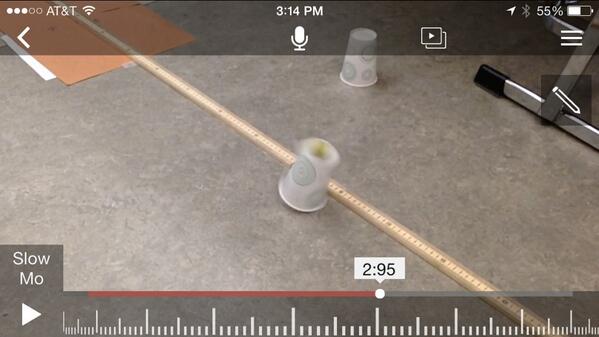
Here is the video of one of the groups who had first time success.


Challenges are a great way to engage your students with actual hands on problems.
Enjoy.


Tuesday, June 16, 2015

#MIMODPHYS15

One day to go!

So the #MiModPhys15 workshop starts tomorrow here in Grand Rapids and I couldn't be more excited.  And this year, I am nervous as hell!  What is up with that?  This is the 6th year that I've been running (with great co-facilitators) a modeling workshop; you'd think that after all of this time I'd be less anxious, not more.  But alas, that's how I'm feeling.  I told my wife, "I'm in full on freak out mode!"  I suppose once I get into the workshop room and set up I will start feeling a little better but right now I am so excited I feel like I'm going to explode.

Let's talk about Grand Rapids...how fired up am I that we're in Beer City?  For those of you who know me you know I'm a big time beer drinker; not big enough to brew my own, but I love a good IPA.  So to be in a place where they are plentiful excites me beyond words.  I am not sure how much it'll help my productivity but I have my list and I'm ready to get a start on it.

One of the aspects of a good modeling workshop (both my opinion and that of David Hestenes) is a community feel that comes from; 1 the group learning and 2 a sense of community that stems from social interaction outside of the workshop.  How do the facilitators create that sense?  First of all, it is difficult.  The workshop itself is a very intense 8-4 experience.  On to of that we ask the participants to do homework.  The nerve!  Does anyone really want to hang out with the facilitators and other participants after a full day of doing so with an hours worth of readings looming?

The original modeling workshops were held at Arizona State University.  That means that 
most of the participants had flown in and many were staying in the dorms together.  There was an instant sense of community because we were all staying in the same place.  With our workshop there are some people staying in hotels, some at home and some camping (at least I think there are some camping).  So how do we create this feel with such a disparate experience.  

I vote for beer.  

I don't mean that we have been during the workshop (although there are times when I am sure it would help).  But I mean more than beer that communal experiences like going to a bar that create this feel.  I would like this to be more than just something that we do in the day, I want it to be something that we reflect on for years to come; "Remember that summer when we did that workshop in Grand Rapids..." that is the kind of experience I am looking to provide for the participants.

The whole goal for the workshop is to:

CHANGE PEOPLE'S LIVES

Anything less is a missed opportunity.  The participants come to me having committed so much time and energy to what they hope is a worthwhile pursuit.  The goal is to help them see that not only is it worthwhile, but meaningful; life changing!  If at the end of the workshop you don't feel that I've helped you change your life, I have wasted your time.  

So how do I combine an increased knowledge of content with an advanced pedagogy and a communal, social learning experience?  Modeling workshop.


Thursday, July 24, 2014

Southwest Michigan Modeling Workshop Day 15

The last day of the workshop started with a breakfast prepared by the participants of pancakes, bacon and sausage!  It was a great way to end the workshop but it got us kind of a slow start.

Reviewing our circular motion idea from the previous day we started with a demonstration where I spun a stopper over my head and released it!  I asked for observations of where it went.  I did this several times with a stopper basically flying around the classroom!

I had them then draw a motion map for the stopper.

We then reviewed the aspects of circular motion that constitute the model.
With the major ideas in agreement I asked them to draw force diagrams for three specific situations:
1. A rider on a merry-go-round (not the one with the horses)
2. A rider on a loop of a roller coaster
3. A rider on a carnival ride called the rotor or the gravitron


In each case the unbalanced force must point toward the center!
Here is where things got interesting.

We know that the unbalanced force points toward the center.  In my classes we call this the Funbal.  Some people call it the Fnet.

Here is the key to getting this - there is a vocabulary word that is associated with this unbalanced force.  It is called the centripetal force (let's use Fcent).

The idea is this:
Funbal = Fnet = Fcent

They are all the same thing!  I gave each group a stopper on a string and asked them to spin them around and feel the factors that they think affect the force they are feeling.

Each groups comes up with the idea that more speed --> more force and that more mass --> more force.  In addition each group had an idea that the changing the radius had an effect on the force but couldn't decide if more radius meant more or less force.

So we asked them to put the three variables into an equation that made some sense to them and show how the units worked out to N.

Not the best way to do this but a quick and dirty way.
After that we checked with the Google.

They then got to work on unit 8 worksheet 1.  This was a serious struggle for them but mostly because it is really hard.  The circular motion unit is a culmination of every model that we've developed through out the year/workshop and is at the limit of most participant's understanding of physics.


I then hung the Flying Pig and asked the participants to find the tension in the string holding the pig.


It is an easy practicum challenge but the kids like it!

Then we set up a hard practicum challenge.

The idea is simple.  We gave each group 3 or 4 pieces of string.  They tested the strength of the string.  Then they created a pendulum with a mass of their choosing at the bottom.  They raised to an angle they calculated and let it swing.  Then they raised it 10 degrees and as it swung it had to break.

This is a little challenging but they got it to work!


And all of the sudden we were done.
We gave the FCI post test and had the participants do the end of workshop evaluations.
Then we cleaned up, gave out door prizes and headed off into the sunset.


Southwest Michigan Modeling Workshop Day 14

There wasn't any reading from the previous night so we just jumped right in with white boarding the speed and energy lab from the previous day.


There is clearly a square root relationship here.  I had them set the boards aside.

The next question is, "What, if any, relationship exists between the energy stored in the stretchy string and the vertical height up a ramp?"  They took the same set up and just lifted the far end of the ramp.


The more energy they put into the string (by stretching it farther back) the higher up it goes.


This one shows a linear relationship.  Again I had them set their boards aside.

Lastly we asked, "What, if any, relationship exists between the energy stored in the string and the slide distance?"

They took the original set up and substituted a wooden block for the low friction cart.


The more energy they put into the string the farther it slides.  This is somehow related to the energy relesased to the surroundings.


This relationship is also linear.

The real question is, when you have all of these boards with the correct relationships, how do you get to the actual equations?

This takes a bit of hand waving and it pretty much teacher led.  But what is the actual point?  For the students (or participants) to get a sense of the energy transfer and conservation.  The mathematical equations are only one part of the whole energy model and I don't think they should be the main focus for anything.

So what did we do?  We looked them up on Google!  Yep - I used the Google to verify that what they got in the lab actually matches the accepted equations for the different storage mechanisms for energy!

Once we were finished with the white boards they started unit 7 worksheet 3b.

Unfortunately we were on the second to last day and we skipped white boarding and discussing the worksheet :(

I wanted to get to a practicum challenge however.  Here is what we did.  For each group we set up a clamp on a table and put a long rod in the clamp.  I used a 90 degree clamp to attach a short rod to the long vertical rod.  I hung a spring on short horizontal rod and gave each group an object of known mass.  I also gave each group a small drinking cup with aluminum foil on the top covering the opening.

The task was to adjust the height of your rods to that when you released the mass, from the height of your choosing, it would touch the foil without breaking through.


The video above shows a winner!  The rest of the groups were very close - I mean within a few centimeters.


After that was all done we needed to so a circular motion intro.  I started by swinging a rubber stopper attached to the end of a string above my head in a horizontal circle.  The questions were:

- how do you find speed?
- is it accelerating?

I had them all draw the system schema for the stopper and then the force diagram.

Traditional physics students always try to put an outward force on the stopper.   However, with the system schema in place there are only two forces and no one seemed to be confused.

The last question was - in what direction is the unbalanced force?


This is a three dimensional representation of the force diagram for the stopper at four different locations.  They were easily able to see that the unbalanced force always points inward toward the center.


Southwest Michigan Modeling Workshop Day 13

Today started with one of the most important readings that we will do this summer - the Swackhammer article called Making Work Work .  This is an article that Swackhammer started in the late 90s and finished in the early 2000s.  I got a hold of it when I was at ASU in 2005 and is all about ENERGY!

The research into student conceptions of force and motion has been ongoing since about 1980.  However, research into the energy conceptions has only been going since the late 90s.  So the research is pretty recent (by the workshop standards).   Swackhammer posits that energy is just energy and that the only thing that differs is where/how it is stored.  Calling energies with different storage mechanisms different "forms" leads to the idea that they are fundamentally different.  In addition, the idea that work can be defined by an equation divorces is from its conceptual meaning.

Normally I would have thought there would be a participant uprising (last year there was almost a fistfight) but the participants were more like, "Yep - that makes total sense" which means that the brainwashing we've been attempting for the past 4 weeks has been successful. :)

They liked the bar charts in both the Swackhammer article and in the Van Huevelen article  Multiple Representations of the Work Energy Process.  This was a bit older than the Swackhammer article but the participants still got a lot out of it.  They really liked the bar charts which is good because we used them a lot later.  They didn't, however, like the usage of the term "potential" energy.  And neither do I.

If all energy is stored somehow and knowing where / how it is stored then what exactly is potential energy?  Just calling it that doesn't help us understand where / how it is stored.  And actually it makes is sound like it is not actually energy but is is "potentially energy".  I say:

 LETS GET RID OF POTENTIAL ENERGY 
AS A CONCEPT and a VOCABULARY WORD FOREVER!

I know that that is a pipe dream - we'd have to change every physics text book forever but really, if we're going to be as explicit as possible with our language to promote actual student understanding why wouldn't we change?

After the readings we had the participants facilitate the white boards for the pie charts worksheet we did the previous day.  This is always an adventure because that particular worksheet is super vague and there are a ton of correct - but different answers.


One of the things I tried to do this year - and failed badly - was to give the participants as much practice and guidance in facilitation as possible.  The problem is that facilitation is very hard and because I've been working on it for 14 years, I make it look kind of easy.  However, I do not know exactly what I do or how to do it.  This was a strength of the woman with whom I taught the previous 4 years of the workshop but this year I have sucked at conveying the "what" and the "how".

Nonetheless, the practice is still important and the "student modes" of the participants is getting really good.  There was a ton of good discussion of the pie charts and it prepared us for the bar charts.

One of the long discussions that we had was, where does the energy go during sliding and/or during a collision?  I did a favorite demo where I had them crash two 2-inch steel spheres together with a piece of paper between them.


Both of the articles showed energy transfer and conservation through bar charts.  I asked the question, "Why are these better and worse than pie charts?"  This sparked a bit of discussion and from there I did a bit of direct instruction on how I think bar charts should be constructed.  From there I set them to work on unit 7 worksheet 3a.

When they were finished we broke them up into two groups and had them facilitate some white board discussion.  Again, I would have loved to give some insight into how to do this better but just let them practice blind.  I'm going to have to work on that for next year.

This is when things got interesting.  I had one of the participants stretch a spring and asked how it felt.  My question, "What, if any relationship exists between the stretch distance and the force by the spring?"  At this point we are very well versed in the inquiry lab procedure so they pushed through it very quickly.  They made white boards and we asked the question, "How are they the same and how are they different?"

The participants notices that all of the graphs were linear and that the slopes were all different.  This lead to a conversation as to why they were different - and they defined the slope as the spring constant as a measure of the tightness of the spring.  Cool.  We used their equations to develop the general idea F=kx.

This is where the "hand waving" begins.  I asked them to look back at their white boards.  My question was, "When we stretched the springs, were we storing energy in the spring?"  Their answer was, of course, yes.  "So then where is this energy on your graphs?"


This is a rather obscure question but one that needs answering.  The reason I don't like it is because no participant or student would ever come up with it themselves.  This the hand waving.  Because they are stumped by the question I ask a follow up.

"When we look at a graph what are the key components that we're examining?"  They listed:
1. The values of the points themselves and trends in the data
2. The slope
3. The intercept
4. The area

If these are the things that we look for on the graphs are any of these the energy?  Because we already examined 1-3 on our list, we were left with #4 and we defined that as our energy!  I had them write an equation for it and substitute in the F=kx from above and presto we have our first energy equation.

I don't love pushing them into this definition of energy: the area under a force distance graph, but its all I've got now.  In my 15 years of practice I haven't come up with or seen anything I like better so for now we'll stick with this.

The participants were fired up (in a good way)!  From many of them I heard, "I knew that equation but never knew where it came from!"  I love that.

Where to go from here?  I set up two clamps at the end of a lab table with a track between them.  I stretched a rubber band between the clamps, over the track, so that they could pull the cart back against the string and if they let it go the cart would zoom down the track.


The question is, "What, if any relationship, exists between the energy stored in the string and the speed of the cart on the track?"  There was some discussion of how to find the energy stored in the stretchy string but in the end they were able to graph the relationship.

Long Day!


Tuesday, July 22, 2014

"It must be nice to have summers off"

How many times have I heard this, "It must be nice to have the summers off!"

I can't believe that we still, as teachers, have to hear the same bullshit rhetoric from the very same people who entrust us to raise their kids!

You would think that I am either completely tired of hearing it and want to lose my marbles when I do OR that I've heard it so much that it no longer phases me.  I have to say that I am somewhere in the middle.  My reaction to the idea or the phrase or the ensuing conversation has changed recently and I'm not sure why.  Maybe I'm getting older and with age comes some perspective.

A couple of weeks ago I was out on a pontoon boat on one of Michigan's beautiful inland lakes drinking beer with some strangers.  They were the nicest people; 4 families who meet at the same place every year for a week in July and have been doing so for many years.

These people knew how to party.  We met them on a sandbar in this lake and they had already pulled out a long folding table and set up a beer pong game.  The competition was fierce!  Frankly the way they were "playing the wind" with their throws made me think about the physics involved in a way I shouldn't be while drinking that much beer!

I struck up a conversation with one of the 40 something adults and in true middle class fashion we asked each other what we did for a living.  I said that I was a teacher and immediately braced myself for what was coming.  Without missing a beat he said, "It must be nice..."  I use the ellipses here because I had stopped listening at that point.  Nonetheless, he went on telling me that he is an autoworker and he gets the first two weeks of July off every year and that was it for him and how jealous he was that we get like 9 straight weeks...

I didn't bother to correct him in that I was actually still working and would be for a few more weeks because his point was clear; teachers have it easy.

The most interesting part is that for those who don't know me I am quite confrontational.  With us in the conversation was an very good elementary school teacher I know and she was looking at me like,"Oh no, Don is going to blow!"  But I didn't make eye contact with her and let this guy go on with his opinions.

Why didn't I lose my shit on this guy?  Because it occurred to me recently that regardless of this guy's naive opinions of what we do or  even worse the disdain of much of the public for teachers, they still need us!  In fact, in this ever increasingly changing world, then need us more than ever!

For the past 5 years, after the school year is over, I have been running a 4 week, very intense workshop for physics teachers.  This job makes my teaching job look like a walk in the park.  I work with dedicated physics teachers and run this workshop like a physics teacher boot camp.  It is 8-4 every day for 15 straight days.  Each day is like a week of school year content and it exhausts me beyond belief.  During this time I don't get to see my wife or kids in a way that is meaningful.  But I do it because good teaching matters.

Earlier this week I was asked if I would be able to run two workshops next year.  I politely declined because my wife and I would really like to spend some time together (and with our kids) in the summer.

We sacrifice quality time during the school year knowing that we would make it up in the summer.

The educational professional who offered me the two workshops then quipped (rather passive-aggressively) "Oh, the rest of us have to work 12 months.  But you teachers..."  I let it slide because I knew he was joking but it was all I could do to NOT go through the phone and throttle him!

I know that some of your day jobs are just that, "day jobs".  That you get to leave it at work when you go home at night and on the weekends.  But when your job is raising the country's children; literally shaping the future of the nation, we, as teachers, take it very seriously and frankly need some time to regroup!  I know that every parent gets frustrated with their children - imagine dealing with 150 of them every day (or worse 25 for 8 hours each day).  Our job is serious and a couple extra weeks off in the summer is a necessary part of the job to do it effectively.

Maybe the problem is that too many of the general public aren't aware of what most teachers I know do with their summers.  Yes, we do take our kids to the pool.  And yes, we vacation.  However, many of us teach, all of us read the whole goal is to get better at the job.  I have a stack of summer reading and none of it involves vampires and all of it involves leadership.

My point is this - to the general public:  for our job raising your kids,don't you think we deserve a little extra time off just so that we can do that job effectively?

Oh and by the way - you're welcome.


Wednesday, July 9, 2014

Southwest Michigan Modeling Workshop Day 12

Today was a weird one.

We started the day discussing the readings - the first couple of sections of chapter 4 and an important reading by Jackson, Dukerich and Hestenes and the effectiveness of Modeling Instruction.

The Arons reading was fine but I think the participants are kind of over it.  The topic was about 2 dimensional motion and vectors.  I think at this point they understand where Arons is coming from and aren't surprised by anything he writes.  However, it is still good for them to see someone besides me talking about the importance of constructing all meaning before attempting to name it.

After the Arons article we looked at the article entitled Modeling Instruction: An Effective Model for Science Instruction.  This is the most recent article that we read in the workshop and is basically an argument about the efficacy of modeling instruction.  The participants felt that the article would be a good primmer for an administrator.  I kind of agree.  One of them felt, however, that an administrator would really need a one-page condensed version for easy digestion.  I found that kind of funny.

This article led us to a discussion of how the participants could start the year to get the administrators on their side early.  It will be hard for them to implement a whole new methodology.  It will be new and different for the kids - who may rebel a bit and if the administrators are already on their side.  

It turns out that I'm more of a big picture guy.  I see what I want to do and how I can make it happen but mostly hope that it all works out in the end through divine intervention.  I normally surround myself with those amazing detail oriented people that help me fill in the specifics, however, this summer's workshop I am flying mostly solo.

Which means that occasionally stuff falls through the cracks.  Exhibit A - when I forgot to do the free fall acceleration lab.  Oops.  We had to go back like 3 days later and fill it in.  That one was actually as much of a sequence error as an oops.

But today's oops was exactly that.  At the end of last week we were all exhausted.  We finished unit 5 and were ready to move on...or so I thought.  We never white boarded worksheet 4.  In my head last week I was thinking, "We'll just finish worksheet 4 on Monday."  But when Monday came I totally forgot and we moved on to unit 6.  It wasn't until the end of Monday that I remembered so we had to white board and discuss worksheet 4 this morning.

I was thinking that maybe we could just skip it.  Unfortunately we can't because the participants need more practice facilitating their own discussions.  Every year that we've done this the most adamant comment at a follow up session is, "I wish we'd had more practice facilitating discussions."  I wish you'd had more practice also.  However, every time we facilitate it takes like a whole hour and that is one less hour for content!  So after the reading discussions we took the rest of the morning to white board and discuss worksheet 4.

After that we jumped BACK into our discussion of energy.  Yesterday we kind of decided that we didn't have a coherent sense of energy and definitely didn't have a definition.  So today we started with listing all of the different energy types.  The participants, much like the students, came up with about 15 different types from what we expect; kinetic and elastic to some out there examples; green energy and biomass.

Probing the students here and getting on the board what is in their heads is crucial.  The point is that nothing that I'm writing down comes from me, it all comes from the students.  They are their ideas and concepts, I am just recording them.  So although it may seem like a traditional lecture set up with the teacher at the board the generation of content is upside-down.

To start to analyze their list in a physics kind of way I imposed the first rule of energy;

All energy is stored energy and you must be able to say where/how it is stored and/or how it we notice it

This rule puts students in a position to make their energy concept more concrete.  I used a bed spring and pushed it downward with a tennis ball and then let go.  The ball popped upward which begs the question, where was the energy stored?  Clearly it was in the spring - and I know that because I saw the spring compressed.  Then it was transferred to the ball and I know that because the ball is moving.  

We used this rule on our list to make sure that everything they suggested had a storage mechanism or could at least be observed as being stored.  The main reason I do this is to deal with the "potential energy problem".  For too long teachers have just called it "potential energy" without a coherent of where or how the energy is stored.  This took an intuitive leap by the participants but I suggested that it was stored in the gravitational field.  This is not awesome but is the best explanation that we have.

I introduced the idea of pie charts, did a couple of examples and then they got to work on unit 7 worksheet 1.  They white boarded the problems and we set them up to facilitate by themselves.

Long day - I hope to wrap up energy tomorrow.


Monday, July 7, 2014

Southwest Michigan Modeling Workshop Day 11

Back from a 4 day break and feeling awesome!  Although it seemed like the whole group of participants had "A case of the Mondays"!

None the less we ploughed ahead.  The problem is that there isn't any time to wait, pause or take stock.  We want to get through so much material so that the participants are armed with everything they'll need to be successful, however, real learning takes time!  So we push them harder but have to temper our pace with their learning.  Ugh, its hard.

Anyway - today we started with free fall.  We had already looked at the free acceleration (which is sometimes called free fall acceleration or acceleration due to gravity).  I drew a man on a roof dropping a ball.  The question is, we know how fast the ball is moving at each second, but how do we know how far it has fallen?

We drew a velocity vs. time graph and they shaded the area to find the displacement.  
This is not new - it is an application of the constant acceleration particle model and the participants liked the fact that it seemed to be kind of a review of something they'd seen before.  

They completed worksheet 1 as Laura and I walked around checking for understanding.

From there we did the "paradigm lab" for the projectile motion unit.  I shared with all of the participants a video of a steel ball thrown across the classroom.  


The questions is: as you watch the slow-mo version of the ball's flight, what happens to the vertical spacing of the ball's positions and what happens to the horizontal spacing of the ball's positions?  

They used an old-school overhead transparency to mark the position of the ball and then answered the questions.  It appeared that the horizontal spacing stayed constant and that the vertical spacing changed.  I asked about the forces and if this seemed consistent with what we know about the acceleration of the ball based on those forces.  

From there they jumped into worksheet 2.  As they completed it again, Laura and I walked around engaging in dialogue, asking extension questions, as always, checking for understanding.  We asked them to put a scale version of the motion map on a white board and MAN did they struggle!

But we got out of them what we wanted, deep thought about projectile motion without having to rely on the equations as a crutch.

Textbooks often put free fall and projectile motion before the forces unit.  This is, in my opinion a serious problem in that there is no reason for the motion.  Why does an object move with a constant velocity in the horizontal direction?  Why does it move with a constant acceleration in the vertical direction?  Without knowing about the forces there is no justification for the motion.  I suppose you could just observe it and go from there but why not have a complete picture?

After that we did some arts and crafts.  This wasn't my finest moment but I still think it worked out well enough.  I had them cut strings and tie them to beads so each bead hung at lengths of 5, 20, 45 and 80 cm; these are the same distances that a freely falling object falls in 1, 2, 3 and 4 seconds.  I then asked them to tape them to a meter stick at equal horizontal intervals to model constant velocity.  They were able to see how the beads modeled the parabolic motion of a horizontally shot projectile.  

I then got confused, gave bad directions, and wanted to curl up and die.

From there we did two practicum challenges.  

The first was a steel ball bearing rolling down a ramp on to a track and then off.  The goal was to hit the top of the cup on the floor.  Why the top of the cup and not into the cup?  I suppose no really good reason.  My thought was that with a heavy ball and a light cup it wouldn't go in but just tip it over.  If it hit the top then it might bounce right off!  How cool would that be?  

But frankly I don't really try to do everything perfectly in these workshops.  I occasionally fly by the seat of my pants or am purposefully vague.  Because the teachers need to figure most of this our for themselves!  I want them to say, "What was Don even doing?  This is way better if I just ________."  I hope they take this skeleton of  a structure that I've imposed and make it their own.  If they don't; if they try to imitate me they won't be as successful.  

So that is the question; how do you provide enough structure for it to make sense but not enough so that they are just following along and imitating?

The groups were quite successful with this one!


The second practicum involved a PASCO Projectile Launcher.  I launched the little yellow ball and from the table to the floor.  I then assigned each group and angle and told them they had to hit the top of the cup.

This was wicked hard!  In past workshops I've had a couple of content experts, teachers who were so good with the content (after teaching for 15 or 20 year) that nothing I threw at them was really hard.  But this group if made up of new (some super new) teachers and others that haven't ever had to teach at this level that the activity proved to be WAY hard.

But with a little coaching they were able to succeed on a level with which everyone was comfortable.  
Some groups even hit top of the cup.

Embedded image permalink


This qualifies as a "really hard" physics problem and the fact that a group got it to work is amazing!


Variation and Measurement Labs

I have been Modeling – teaching physics using the Modeling Method for about 14 years now.  I took my first training in the summer of 2000 with a very dynamic teacher from Michigan, Mark Davids, who had been modeling then for at least 10 years, having received his training in 1997 and 1998.  I mention the lineage because the modeling materials have changed over time and something that I think is so important has been lost.

That is serious practice in graphing and analysis.

When I first took the class the facilitator had us to between 8 and 10 labs where we took data, graphed it (using some automatic graphing program or calculator) and analyzing the graphs - writing equations, describing the relationships, etc..  I thought that this is the way that all modelers do it.  But when I got to Arizona State (where I studied modeling for the next couple of years) I found out that no one did it this way.  They all used the script from the modeling materials that suggested doing just the pendulum lab.  

I was like, "What?  None of those are even a linear relationship!"  

How are kids going to experience all of the relationships by only doing a pendulum?  In my experience there were myriad labs with almost all of the standard relationships represented.  Here is my list of all of the labs that I have the kids do in the first week.

Linear Relationship
Circles #1: Circumference vs. Diameter
The participants measure the circumference of various cans, lids and bottles with a string and the diameter with a meter stick.

Rods: Mass vs. Length
The participants measure the length of a bunch wooden dowels cut from the same long dowel with a meter stick and the mass with a triple beam balance.

Tiles: Mass vs. Area
The participants measure the area of pieces of white board with 1 cm x 1 cm grid paper and the mass with a triple beam balance.  I cut a white board into small pieces of various sizes and shapes between 50 cmxcm and 500 cmxcm.

Spheres: Mass vs. Volume
The particpants measure the volume of 5 differnt steel ball bearings by dropping them into a graduated cylinder and the mass with a triple beam balance.

Cups and Dice:  Mass vs. Number of Dice
The participants count the number of dice in a cup and measure the total mass with a triple beam balance.  This one is particularly interesting!


Parabolic or Quadratic or Squared Relationship
Circles #2: Area vs. Diameter
The participants measure the area of circles with 1 cm x 1 cm grid paper and measure the diameter with a meter stick.


Square Root Relationship
Pendulum #1: Period vs. Length
The participants measure the period of the pendulum with a stop watch and the length using a meter stick.

No Relationship or No Variation
Pendulum #2: Period vs. Mass 
The participants measure the period of the pendulum with a stop watch and the mass by reading the mass on some "physics class masses".

Pendulum #3: Period vs. Angle
The participants measure the period of the pendulum with a stop watch and the angle by using a protractor or other "angle-o-meter".

Inverse Variation
Baseball Balance: Distance to Center vs. Mass
The participants vary the mass on one end of a meter stick and change the distance from the center by sliding it toward or away getting it to balance.   


There isn't an inverse square relationship here but that doesn't mean I can't do one.  

I am tired of teachers who say, "these kids don't have any skills."  I am like, "then just teach them what you want them to know!"  

With in these labs I teach my kids how to measure with meter sticks, stop watches and balances.  They learn to make white boards, to graph with the computer and to analyze their graphs; all of the skills they will need for the whole year!  And I am in the room coaching and watching and hinting.  I get to know the kids and their skill level.  

I have been running Modeling Workshops in Michigan for 5 years now and have done these with my participants and I bet if you ask any of them they will support my claim that these are valuable parts of their classes.


Southwest Michigan Modeling Workshop Day 10

Two-thirds of the way through the workshop and I am exhilarated and exhausted!

On day 10 we had some very challenging physics questions to tackle.  The first involved a box on a ramp (what we physics people call an inclined plane problem).  The second involved the Atwood's Machine - and half or modified Atwood's Machine (what we physics people call a two-body-problem).  

The day started with a discussion of the readings from Arons.  The reading was about the common vocabulary of physics with regard to "gravity".  In our modeling class we don't use the word "gravity" at all; in fact I call it the "g-word" and don't let anyone use it!  There are much better ways to refer to things kids usually call "gravity" and Arons goes into detail in this section.
I couldn't agree more with Arons and we talked all about our own conceptions and his observations.

We then embarked on the ramp problems.  After 4 years of leading a workshop (and 15 years of teaching) I still don't have a great way to get students or teachers to discover or construct on their own how to draw a force diagram for a box on a ramp.  It is very frustrating.  So I, instead, wanted to see if I could somehow link what we were doing to this new process.

Earlier in the workshop we had referenced a section of the Arons reading where he suggested a flashlight demo to help students resolve vectors into their component parts.  Take a meter stick to represent a vector and lean it against a wall.  How would you know how long to make the horizontal and vertical components.  Arons says to take a flash light and shine it parallel to the floor and on the wall you'll see the vertical component.  Then take the flash light and shine it perpendicular to the floor and you'll see the horizontal component.

Our participant have really embraced this idea and have even gone to calling the components the "shadow arrows".  

So the question is how does one draw the component vectors for a box on a ramp?  Traditionally we were told to just "rotate the axis" and then break up the weight vector into its component parts.   But this instruction was given without a reason or context.  It was, "just the way you do it".   So I practiced and got good at it but never really knew why.  And I want at least a little more for the participants.

We decided to use the idea of the flashlight demo to link this new problem to something we already understand.  The rule is:

To find the components shine the flash light parallel and then perpendicular to the surface.

This rule gives us a reason to "rotate the axis".  Since the flash light is orientated according to the surface even if we tilt the surface we can still find the shadow arrows!  Moreover, these arrows have to be, themselves, parallel and perpendicular to that surface.

In the end the participants still had to practice.  But I am more comfortable giving them a little more than this is  "just the way you do it".

Unfortunately I had to show them how to do it, which isn't the end of the world.  I don't mind doing an "on the board" demonstration if it is a particular skill I want them to master.  While finishing, one of the participants asked, "how do you convince the students the angle of the ramp is the inside angle of the component triangle?"  

I was like, "I try never to show them anything they can figure out on their own!"  So I asked them to use the method I just described and then measure the two angles and see for themselves.  

Embedded image permalink


The engineering group above used a bit of technology (my favorite app called "clinometer") so measure the two angles.  Other groups used protractors or those giant Plexiglas triangles from geometry class.  The point is, nobody is confused about the fact that those two angles are the same.  No geometry necessary; convincing needed!

Then they practiced.  This basically took all morning.  Ugh.  Learning is so slow when it is meaningful.  

We then moved onto the dreaded Atwood's Machine problems.  These again are tough for almost all physics students.  Why?  It is hard to say.  Probably because you have to think about two objects instead of just one.  But is that really that much harder?

Apparently so.  As teachers we need to practice our RETROGRADE AMNESIA; remembering back to a time when you didn't know or know how to do something.  

Do you remember back to when you didn't know how to tie your shoes? Do you think you could effectively and easily teach that skill to someone without remembering what that feels like? It is the same with these problems!

The issue, again, is traditionally we were told how to do these and just practiced until we got it right.  This involved drawing a force diagram for each object and then writing a sum of the forces statement for each. This would yield two equations and two unknowns. Then from there we do some math-magic (also known as algebra) and solve for something; the tension in the string or the acceleration. Kind of tough for all but the best students (who are probably just following the procedure without thinking too much about it anyway).

Can we do better? What kind of construct can we apply to this problem that is a bridge between what we already know and this new situation?
We decided to go for a system approach for the modified Atwood's Machine. We started by drawing a force diagram for each body and then asking the question, "What is the role of the pulley?" I suggested that it was to turn the force 90 degrees. What would the force diagram look like if we undid the pulley? Can we then smush the force diagrams together to find the unbalanced force?

We asserted that Newton's 2nd Law applied to systems as well:

a(sys) = Funbal(sys) / m(sys)

Once we had the unbalanced force and mass for the system we could then find the acceleration of the system. This procedure allows us to simplify the large problem into something manageable. The participants, however, had to make that cognitive leap in order to get on board with this idea.

Not too many had a problem and we made sure to work with them and that they had enough practice.


The day ended with a practicum challenge.  They were given a Modified Atwood's Machine and asked to release it and a buggy at the same time so that the little mass on the end of the string landed in the buggy.  The group that was the closest landed it on the hood.


I didn't assign any homework because it was the 4th of July weekend.